
How to resurrect the village in motherhood
Listen
How to resurrect the village in motherhood
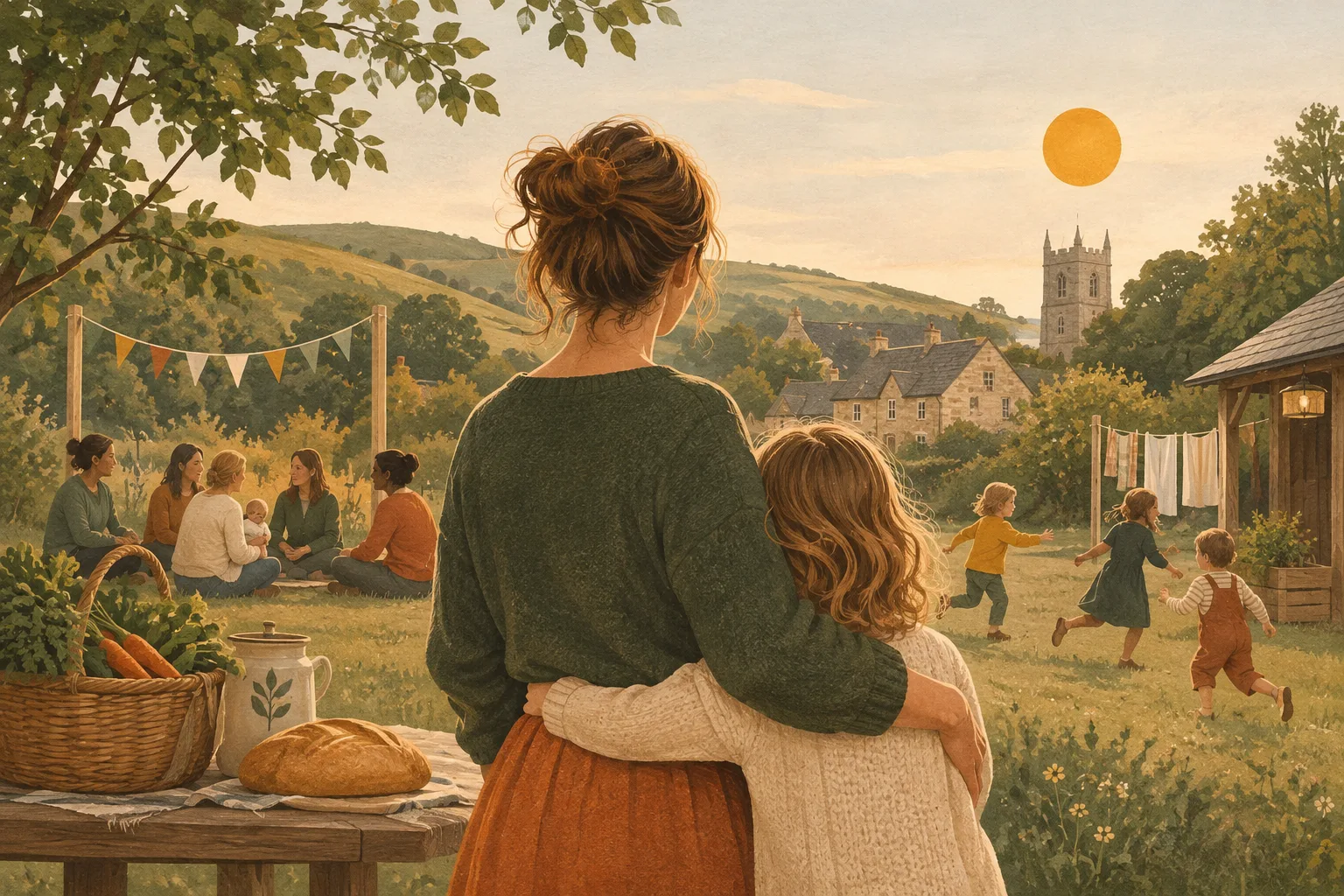
The village we lost
We have lost the village. Most households now are a mother, a father and their children. Either both parents work, or one works while the other holds down the fort at home.
It makes raising children hard. It makes life in general hard. And it is hardest of all in new motherhood, or when you are home educating, because you are doing it with almost nobody beside you.
Every household ends up solving the same problems alone. Who cooks when the baby will not settle? Who watches the children when there is work to be done? Who do you ask when a child is unwell and you do not know what to do? In a village, the answer was always someone nearby. Now the answer is too often nobody.
I have been trying to bring the village back in small ways and to build my own support system. This is what I have done, and what you can do too.
Before the baby: a mother blessing
When I was pregnant, I organised a mother blessing. It was a way to ease my transition into motherhood and to invite my close friends to rally around me.
A mother blessing is a rite of passage. It initiates a woman into motherhood and welcomes her there. It is shaped entirely around what the mother wants and needs, so no two look the same.
Here is how one might look. Loved ones read poems or share their own words. There is a red thread ceremony. Together you create affirmations for the birth. Friends write blessings for the postpartum weeks, or letters for the mother to open when she needs them.
There might be massage, flower crowns, cacao or belly painting. Anything that makes the mother feel very loved and very special, and that helps her cross into this new life, belongs there.
I now offer a mother blessing to every pregnant woman I am friends with or meet. Anyone can arrange one. You do not need any skills or qualifications, only the wish to gather people around her.
If you want to arrange one, begin by asking the mother what she would love. Some women want a quiet afternoon with a few close friends. Others want something more ceremonial. Then invite the people who matter to her, and ask each of them to bring a poem, a blessing or a letter. The rest follows from there.
The first weeks: a food train
A mother blessing is also a good moment to organise a food train. This means fresh, nutritious meals cooked by loved ones and delivered to the mother's door after the birth, so she does not have to think about food at all.
It works because it asks very little of each person. One friend cooks one meal. But together, the meals cover the first weeks, when a new mother most needs to rest, feed her baby and recover.
I cook meals for all of my friends when they have a baby now. When I was the one having a baby, I asked my loved ones to do the same for me in those first few weeks. Asking was part of it. A village only works when people are willing to say what they need.
Three months in: a mothers' circle
When my baby was about three months old, I started a mothers' circle locally. It was for mothers who were doing things a bit differently. We sat in circle, supported each other, shared and chatted.
It became a space for the triumphs and the struggles of new and early motherhood. We shared breastfeeding support. We talked about what we were each going through, how relationships change in parenthood, and how to nurture our relationships with our partners. We swapped tips for when our babies were struggling with anything.
Each week I invited a volunteer speaker to talk about something that would support mother and baby. We had ayurvedic nutrition, baby massage and reflexology, homeopathy for the family, and more.
This mattered more than I expected. Most of my friends at the time had not had children yet. The circle gave me an actual, physical community of mothers, not just friends, and a new circle of people to mother alongside.
Friends are precious, but a friend who has not yet had a baby cannot always see what your days are like. Other mothers can. If there is nothing like this near you, you can start it. All it takes is a room, a time and a few mothers who are glad to sit together.
As the children grow
Our children have grown, and so has the village. We no longer meet in circle, because that does not work right now with a crowd of toddlers and little children. But we still gather.
We get together for home education activities. We go on walks. We share childcare when there is work to be done. We share skills to help our businesses thrive, and each of us offers knowledge in our own area when someone needs it.
We have people to turn to when our children are unwell. We have people to turn to when we have had a busy week and need a nourishing meal, or when there is a lot of work to get done and we need someone to watch our child.
We grow vegetables and share the produce. We swap one thing for another: eggs for bread, a homemade jam or chutney for something from a friend's garden, or housekeeping for a veg box. It is really incredible.
The village changes shape as the children grow. What a mother needs with a newborn is not what she needs with a toddler, and it is different again with a home educated child. The circle came to its natural end, and something else took its place. Let yours change too.
If home education is part of your life, Home education: you may be more able than you think is a good companion to this one.
More ways to start your village
Here are further ideas for getting a village up and running. Keep the ones that suit you, and leave the rest.
- Start a group chat for local mothers, so a quick question or a request for help can reach several people at once, whether it is a late-night worry or a spare pair of hands.
- Hold a clothes and equipment swap, so outgrown baby things move on to the next family and nobody has to buy everything new.
- Set up a small library of tools and books that neighbours can borrow, so one drill or one good book can serve a whole street.
- Share a garden, or hold a seed swap, so growing food becomes something done together and the harvest is shared.
- Buy food in bulk with friends, which brings the cost down and puts good food in more kitchens.
- Pick a regular time for an open-door cup of tea at home, or a meet-up at the park, so people always know where to find each other without needing an invitation.
- Offer to sit with a new mother while she sleeps. An hour of rest can change her whole week.
- Welcome newcomers to your area. Someone new to town is often the one who most needs a village, and a simple hello can be the start of it.
- Invite older neighbours in. They have time, skills and stories, and children can bring them company and a sense of being needed.
- Offer one thing you are good at, and ask for one thing you need. Cooking, mending, gardening, listening and minding a child are all worth something, and the exchange is what makes it a village.
Start with one person and one meal
You do not need a plan, a venue or a qualification. The village I have now began with one blessing, one meal and one circle of mothers, each of which anyone could have organised.
So start small. Think of one person near you who is about to become a mother, or who is in the thick of it now. Cook her a meal and take it to her door. Then do it again for the next one.
A village is built from small acts like that, repeated until people begin doing them for each other without being asked.
If you want to go further into what it looks like when children grow up inside a community, Two Childhoods sets it out.
Comments
Sign in to join the conversationLoading…