
Two Childhoods - children raised in community and children sent to school
Listen
Two Childhoods - children raised in community and children sent to school
A comparison of what each one shapes them to become
There is a question most parents never quite let themselves ask out loud. It sits underneath the school run, underneath the homework battles, underneath the Sunday-night dread that has somehow become normal in households across the country. The question is simple.
Is this actually good for them?
Not is it normal. Not is it what everyone else does. Not is it what we ourselves went through. But is it actually, genuinely, good for the child in front of us — for the person they are becoming, for the life they will live, for the adult they will one day be.
Most parents push the question away because they cannot see an alternative. School is what childhood looks like. Everyone goes. Everyone has always gone. To question it feels almost transgressive — as though the asking itself is irresponsible.
But the question deserves to be asked. And to answer it honestly, we have to look at what childhood looks like when it happens differently. Not in theory. In practice. On real land. With real children. Living a real life.
This is a comparison between two childhoods. One that most children in this country live. And one that some children — a small but growing number — are now living instead.
—
The shape of a school day
Picture a seven-year-old on a Monday morning. She is woken before she is ready, because the institution starts at a fixed hour and the family must arrange itself around that hour. She is hurried through breakfast. She is separated from her mother and father at a gate, often with a moment of distress that everyone has learned to suppress and call normal.
She enters a room of twenty-nine other seven-year-olds. For the next six hours, almost every person she interacts with will be exactly her own age. The adults present are not her family. They are professionals doing a job, holding authority over her, evaluating her, ranking her against the other twenty-nine.
Her day is broken into fragments. Forty minutes of one subject. A bell. Move to another room. Forty minutes of another subject, often entirely disconnected from the first. A bell. Move again. Her attention is required to switch, fully and immediately, six or seven times a day. Whatever was building in her mind during the previous fragment — curiosity, momentum, the beginnings of understanding — is cut off when the bell rings, because the timetable says so.
She is told what to think about, when to think about it, and for how long. She is told when she may speak. She is told when she may move. She is told when she may eat, and what counts as acceptable behaviour while eating. If she does not comply, there are penalties — a word on the board, a missed playtime, a phone call home, a label that follows her through her school career.
She learns, very quickly and very deeply, three things that no curriculum explicitly teaches. She learns that authority is external. She learns that compliance is rewarded and non-compliance is punished. And she learns that her own internal sense of what matters, what is interesting, what is true — must be set aside in favour of what the institution has decided.
She will spend roughly fifteen thousand hours of her childhood in this environment. By the time she leaves it, she will be eighteen years old, and the shape of her mind will have been formed by it.
—
The shape of a day in community
Now picture a seven-year-old on the same Monday morning, but living in a community on the land.
She wakes when she is ready, which is usually early because she has slept well and there is nothing to dread. She eats breakfast with her family — her actual family — and with several other adults and children who are part of the daily life of the place. There is no separation, no gate, no professional handover.
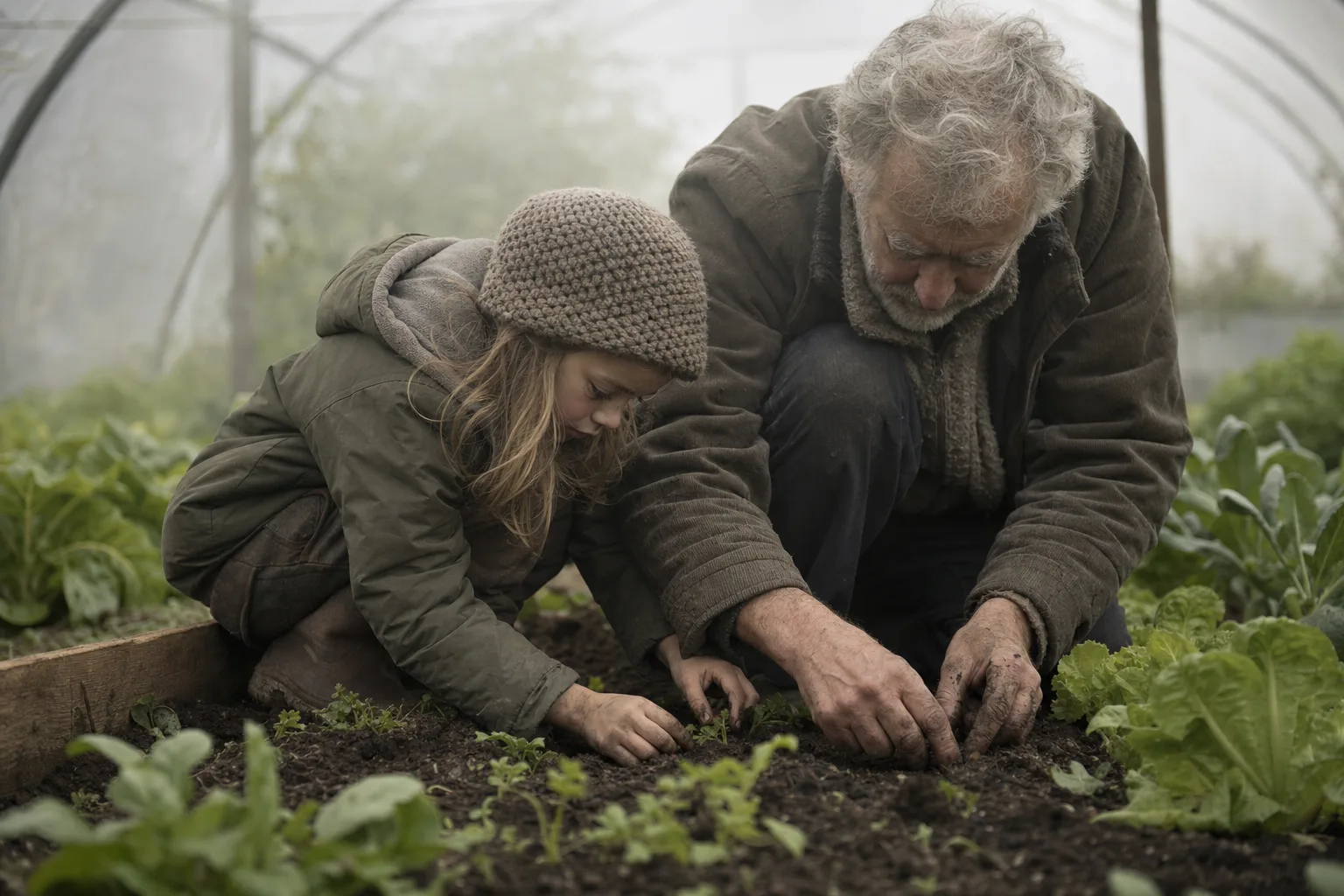
After breakfast, she joins whatever the day is doing. Perhaps the chickens need feeding and the eggs collecting — a task she has done since she was three, and which she now does competently and without supervision. Perhaps the polytunnel needs watering, or seedlings need planting out, and she works alongside a sixty-year-old who has been growing food for forty years and who tells her, while they work, what he is doing and why. Perhaps the kitchen is preparing lunch for thirty people, and she is chopping vegetables next to her mother and a teenager she has known her whole life.
She moves between tasks not because a bell rings but because the work calls for it. Her attention is allowed to settle. When something interests her — the way the bees move, the shape a piece of wood is taking under a chisel, the question of why the lake never freezes in the middle — she is allowed to follow that interest until it is satisfied. No one tells her to stop because the timetable says so. The timetable is the day, and the day is the work, and the work is real.
She interacts, in the course of an ordinary morning, with people aged two, five, nine, fourteen, thirty-two, forty-eight, sixty-seven. She speaks to them as people. They speak to her as a person. She is not being managed by professionals — she is being lived with by family and friends.
She learns, very quickly and very deeply, three different things. She learns that capability is real and earned through practice. She learns that her contribution actually matters — the chickens really do need feeding, and if she does not feed them, no one does. And she learns that her own internal sense of what is interesting and worth pursuing is trustworthy, because she has been allowed to follow it and has seen where it leads.
By the time she is eighteen, the shape of her mind will have been formed by this. And it is a profoundly different shape.
—
Mixed ages, and what they do to a child
Schools are organised by age. This is one of the strangest decisions in the history of childhood, and it is so universally accepted that almost no one notices how strange it is.
In every other human society that has ever existed, children grew up among people of all ages. Babies, toddlers, older children, adolescents, parents, aunts and uncles, grandparents, elders. They learned by watching and imitating those slightly older than themselves. They learned by caring for those slightly younger. They learned how to be an adult by being constantly around adults, doing adult things, in the ordinary course of life.
When you put thirty seven-year-olds in a room together, away from all other ages, something quite specific happens. They mirror each other. The behaviours, the language, the anxieties, the social hierarchies, the cruelties, the obsessions — they all bounce between the children, amplifying. There is no older child modelling something better. There is no younger child evoking the care and patience that older children naturally develop. There is no adult woven into the daily fabric of the group whom they actually trust and want to become.
What there is, instead, is a peer group. And the peer group becomes the source of identity, of values, of approval, of fear. The child looks not to the wisest person available but to the other twenty-nine seven-year-olds — for cues about who to be, what to wear, what to like, what to mock, what to fear. This is not a flaw in the children. It is what happens to any human being placed in an artificial age-segregated environment for fifteen thousand hours.
A child raised in community develops social skills of a quite different kind. She knows how to talk to a two-year-old without condescension. She knows how to talk to a sixty-year-old without intimidation. She has watched conflict between adults resolve itself with honesty rather than violence. She has been included in adult conversation since she could sit at the table, and so by twelve she can hold her own in any company. She is not socially advanced — she is socially ordinary, in the way humans were socially ordinary for most of our existence. It is the school child who is socially anomalous, fluent in their own narrow age cohort and awkward with everyone else.
—
Context switching, and what it does to a mind
The school day's structure — forty minutes of this, bell, forty minutes of that, bell — is something the modern adult world has come to recognise as cognitively destructive. We talk now about deep work, about flow states, about the damage done by constant interruption. We know that the most valuable thinking, the most satisfying creating, the most genuine learning all happen when attention is allowed to settle and stay settled.
And then we send our children into an environment specifically engineered to prevent that.
A child whose day is fragmented into a dozen unrelated pieces never gets to experience what their own mind can do when it is allowed to follow one thing all the way through. They never feel the deep satisfaction of an afternoon spent solving a single problem. They never learn what it is to lose track of time inside a piece of real work. And so they grow up not knowing that this is even possible — let alone that it is one of the great pleasures of being a thinking human being.
The community child's day is the opposite. She might spend three hours learning to use a tool, because the tool is interesting and the project is real. She might spend a whole afternoon on a question she became curious about at breakfast. She might come back to the same piece of work, day after day, for weeks, because no one rings a bell to tell her she's done.
She learns, without anyone teaching her, how to concentrate. How to persevere. How to immerse. These are not academic skills. They are the skills that, in adult life, separate those who can actually do things from those who can only manage their inboxes.
—
Authority, penalty, and what they install
Perhaps the most consequential thing school teaches is something it never names.
It teaches that authority is external. It teaches that the rules come from above. It teaches that compliance is the route to safety, and non-compliance the route to penalty. It teaches that the right response to a powerful figure is deference, even when the figure is mistaken, even when the rule is absurd. It teaches that the child's own judgment is suspect, and the institution's judgment is correct.
This is not an accidental side-effect of school. This is, in many respects, the deepest function of school. School was not designed to produce thinkers, makers, or free human beings. It was designed, in its modern form, to produce people who would show up on time, do what they were told, accept hierarchical authority without question, and be useful in factories and offices. We have changed the factories, but we have not changed the school.
The penalty structure is part of this. A child who learns from age five that not complying brings punishment — and that the punishment comes from someone with power over them — is being trained in a quite specific relationship to authority. She is being trained to assume that authority over her is legitimate. She is being trained to assume that the appropriate question is not "is this rule right?" but "what happens if I break it?"
When that child becomes an adult, she carries this training into every encounter with institutional power. With the tax office, the council, the regulator, the policeman, the doctor, the employer. She defers automatically. She assumes the institution has authority she has not granted it. She does not know how to occupy her own ground, because she has never been allowed to occupy it.
A child raised in community learns something quite different. She learns that her parents are not authorities over her in the institutional sense — they are older humans she loves and trusts, whose guidance she takes because it has earned her trust, not because they hold power over her. She learns that rules exist for real reasons and can be discussed. She learns that "because I said so" is not a sentence anyone she respects would actually use. She learns to ask whether something is true, not whether she will be punished for questioning it.
This child grows into an adult who can hold her own ground without aggression, who can disagree with power without trembling, who can think for herself in the presence of institutions that would prefer she did not. This is not rebellion. It is sovereignty in the older sense — the simple, settled ownership of one's own life.
—
What is actually being learned
Schools justify themselves by reference to what they teach. Maths, English, science, history. The curriculum.
But every honest adult knows that almost nothing they actually use in life came from the curriculum. Most of what they learned in school they have forgotten. Most of what they use every day — how to manage money, how to talk to a difficult person, how to fix something that has broken, how to raise a child, how to start a business, how to grow food, how to be in a relationship, how to think clearly under pressure — none of this was taught in school. They learned it after, often painfully, often by accident, often too late.
The community child is learning these things from the start. By two she is scattering seeds. By three she is collecting eggs and feeding chickens. By eight she is maintaining tools, helping with younger children, taking on small projects of her own. By twelve she is carrying real responsibility — running aspects of the daily operation, taking decisions, being trusted. By sixteen she can run most of what the community does, because she has been running parts of it for years.
Her mentors are not professionals. They are the several capable adults actually present in her life — unhurried, attentive, teaching by doing. She does not need lessons in "life skills" because her whole upbringing is a life skill. She does not need careers advice because she has watched adults at work since she could walk, and she knows what work looks like and what she is drawn to and what she is good at.
This is what childhood was, before it was industrialised. It is practical, participatory, rooted in capability rather than compliance. And it produces, by eighteen, a young adult of a kind that is now genuinely rare — competent, grounded, useful, capable of starting a life of their own without first needing to recover from the way they were raised.
—
The separation from parents
One of the strangest features of modern childhood is how little of it is spent with the child's own mother and father.
A child in school is separated from her parents for roughly thirty-five hours a week during term time. Add commute, homework, extracurricular schedules, and the actual quality time remaining — the time when parent and child are together and present and not exhausted — drops to almost nothing. Many parents will admit, if pushed, that they get perhaps an hour a day of real presence with their child. By the time the child is a teenager, often less.
We have normalised this. We have built our entire society around the assumption that children are raised primarily by institutions and only secondarily by the people who actually love them.
The community child grows up with her parents present in her daily life. Not because they have arranged "quality time" but because the work and the day include them all. Her mother is in the kitchen, or in the garden, or in conversation by the fire, and she is there too, woven in. Her father is fixing something, or building something, or talking to someone about something that matters, and she is there too. She knows her parents — not as occasional weekend figures, but as the actual ongoing presences of her life. She knows what they do, what they think, how they handle difficulty, how they treat other people, how they love each other.
This is not nostalgia. It is the ordinary condition of human childhood across almost all of history. It is school-based childhood that is the historical anomaly, and the consequences of that anomaly — children who barely know their own parents, parents who barely know their own children — are visible everywhere we look in modern family life.
—
The state of the parents matters too
There is a piece of this that is worth naming directly, because it sits underneath everything else.
A parent who is themselves anxious, reactive, exhausted, overstretched, and running on caffeine cannot give a child what calm parenting actually requires — regardless of whether the child is at school or at home. The condition of the parent shapes the child more deeply than any educational arrangement. A child raised at home by a parent who is constantly stressed is not necessarily better off than a child in school whose parent is at peace.
This is why, in any genuine alternative to the school-based life, the inner work of the parents is not optional. The community at Zen Jungle is built on this recognition. Most attempts at intentional community fail because people arrive carrying the patterns that made them unhappy in the old life. The location changed; the mind didn't.
The dissolution of the conditioned patterns that generate anxiety, reactivity, and the constant noise of an overactive mind is what makes the rest possible. A parent at peace can raise a child in peace. A parent in turmoil cannot, no matter how beautiful the land or how good the intentions. This is why the inner work and the outer life have to come together. Either one alone is incomplete.
—
So what becomes of these children?
A child shaped by fifteen thousand hours of institutional schooling tends to emerge at eighteen with a particular profile. She has been taught what to think, when to think it, and how to perform thinking in a way that gets marks. She has learned to defer to authority and to fear penalty. She has spent her formative years among only her own age group, and she is socially fluent within it but often uncertain outside it. She has rarely concentrated on anything for more than forty minutes. She has rarely done any work that mattered to anyone, including herself. She has been told repeatedly that her worth is measured by external evaluation, and she has internalised that measurement.
She may be academically capable. She may be heading to university. She may have a CV that opens doors. But she often does not know what she actually wants, what she is actually drawn to, or who she actually is — because none of these questions were asked of her, and she was rarely allowed the silence in which they could be heard.
A child raised in community emerges at eighteen with a profile that is harder to summarise because it is more whole. She is competent at real things. She knows how to work with her hands and her head together. She can hold a conversation with anyone of any age. She knows how to concentrate, how to persevere, how to start something and finish it. She has been trusted with real responsibility since she was small, and so she trusts herself. She has not been trained to defer to institutional authority, and so she meets institutions as a free human being rather than as a subject.
She is not always going to be the conventional high-achiever. She may not have a string of qualifications. But she is going to be capable of building a life — and capable of recognising when a life is worth building.
—
What this means for parents asking the question
If you are reading this, or hearing this, and the question we began with is now louder rather than quieter — good. The question deserves to be louder. The cost of not asking it is paid by the child, and paid for decades.
Asking the question does not mean you have to pull your child out of school tomorrow. It does not mean every family can or should arrange their life around an alternative immediately. The point of asking is not to produce a sudden decision under pressure. The point is to look honestly at what is happening, to stop pretending that the conventional arrangement is automatically good for the child, and to begin to see what else might be possible.
For some families, the answer will be smaller — more time at home, more presence, more of the kinds of activities that real childhood used to include. For some, it will be home education. For a few, it will be the deeper choice to build their life on land, in community, where childhood can happen the way childhood was meant to happen.
What matters is that the question is asked, honestly, with eyes open. Because the child in front of you is becoming someone, every day, shaped by the environment you place her in. And no one else is going to make this decision on her behalf with the care that you can.
—
A closing word
There is a place in Devon where forty acres of land hold five lakes, ancient woodland, gardens, cabins, and a small group of people building a life organised differently. Children are part of that life — not separated from it, not delegated to institutions, but woven in. The two-year-olds scatter seeds. The three-year-olds collect eggs. The older children carry real responsibility. The adults are unhurried and present. The work is real and the days are full.
It is one example, among others, of what is possible when the question is asked seriously and the answer is acted on.
If any of this has spoken to something in you that has been quietly waiting to be spoken to, that is worth noticing. The conventional arrangement is not the only arrangement. Childhood does not have to look the way it currently looks. And the life your child grows up into can be shaped by something other than the institution that shaped you.
The first step is the question. The rest follows from there.
Comments
Sign in to join the conversationLoading…